"Consciously we teach what we know, unconsciously we teach who we are." Hamachek, 1999
Mostrando postagens com marcador Curricula. Mostrar todas as postagens

domingo, 22 de março de 2015

Article Summary - Resumo de Artigo

Engineering Education - Is Problem-Based or Project-Based Learning the answer? 

I have summarized an article that is directly related to the EDUCON conference, so I decided to post it.
The modern engineering needs a professional that has more than technological skills and fundamental science of engineering. The labor market need professionals that know how to apply these concepts in practice.
Some observations can be done about the engineering education nowadays. e.g.
- Engineering curricula have topics without integration between them;
- They don't provide design experiences to students;
- There aren't many opportunities for the students improve their teamwork skills;
- The engineering courses must focus more on social, environmental, economic and legal issues, they are just focusing the scientific part of engineering;
- Universities don't provide opportunity for the students learn how to apply their theory knowledge in the practice. Theory and practice aren't integrated.
The engineering institutions must revise their program and course structures and teaching methods to help their graduates be more accepted by the industry.
One of the best ways to change this scenario is to adopt project-based learning or problem-based learning in engineering institutions, it could solve directly 5 of 6 problems cited before and the last one would be solved indirectly.
Some authors say that Problem-Based Learning isn't totally suitable for engineering courses because the knowledge structure of these courses is hierarchical for example, the student can't learn how to calculate a mass balance of an chemical industry if he don't know elementary math unlike medicine, that is such an encyclopedic course, the student can learn in different sequences.
Another reason that problem-based learning would be difficult to implement is that engineer education sector is very conservative, with a technically focused culture.
The problem-based learning may be good for engineer students, but there are a lot of reasons that it would be very difficult to work.
Projects in engineering can vary the time scales, it can take hours, days, weeks or years, but all will relate the theory and techniques of an engineer's specialization.
Project-based learning x Problem-based learning
- Both strategies are based on self-direction and collaboration;
- Projects are closer to professional reality;
- Projects take a longer period of time;
- Projects are more directed to the application of knowledge, whereas problems are more directed to the acquisition of knowledge;
- Project-based is usually accompanied by elementary courses;
- Project-based learning require more management of time and resources by the students;
- Self-direction is stronger in projects.
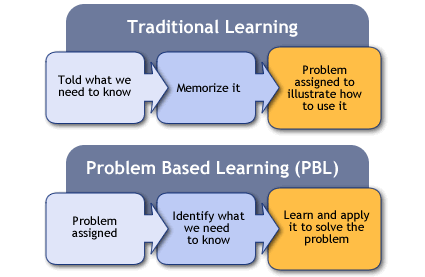
Project-based learning can be applied in individual courses or the entire curriculum, and it can be project-oriented studies and project-organised curriculum.
First one uses small projects within individual courses, progressing to a final project that has the objective of being integrator.
The second is the organization of the entire curricula of the engineering courses in projects and these projects vary in duration from a few weeks up to a whole year and even the whole course. There isn't any engineering course this way.
The ideas of Project-based learning and problem-based learning support each other and emphasize different aspects of learning.
They emphasize learning instead of teaching.
A project has some phases of preparation such as preparation, problem analysis, demarcation, problem solving, conclusion and reporting.
The students who participate in project-based learning are generally more motivated, have better teamwork and communication skills. They have a better understanding of the application of their knowledge and they are more able to use connections by theory and practice.

My personal opinion about the article:
I finally got the main difference between Project-based learning and Problem-based Learning.
It seems that the project-based learning is a very good method to use in my institute in Brazil. I think the vocational courses are the right study degree to start this project on Federal Institutes because the main goal of these is to provide labor to the labor market, if we can use problem-based learning maybe we can motivate our students to work as technicians.

Ensino de Engenharia - Metodologia baseada em projetos seria a solução?

Fiz uma resenha de um artigo que tem tudo a ver com o assunto da EDUCON, portanto estou postando a mesma abaixo.
A engenharia moderna precisa de um profissional que possua mais do que apenas competências tecnológicas e a ciência fundamental da engenharia. O mercado de trabalho precisa de profissionais que saibam como aplicar esses conceitos na prática.
Algumas observações podem ser feitas sobre o ensino da engenharia hoje em dia. por exemplo:
- Os currículos dos cursos de engenharia possuem disciplinas sem integração entre elas;
- Eles não oferecem experiências de design para estudantes;
- Não há muitas oportunidades para os estudantes melhorarem suas habilidades de trabalho em equipe;
- As universidades não oferecem oportunidade para que os alunos aprendem a aplicar seus conhecimentos teóricos na prática. Teoria e prática não estão integrados.
- Os cursos de engenharia têm de se concentrar mais em questões sociais, ambientais, econômicas e jurídicas, eles estão focando apenas a parte científica da engenharia;
- As instituições de engenharia devem rever os seus programas e cursos de forma a alterar as estruturas e métodos de ensino para ajudar os seus egressos a serem mais aceitos pela indústria.
Uma das melhores maneiras de mudar esse cenário é adotar aprendizagem baseada em projetos ou aprendizagem baseada em problemas, isto poderia resolver diretamente 5 de 6 problemas citados antes e o último seria resolvido de forma indireta.
Alguns autores dizem que a aprendizagem baseada em problemas não é totalmente adequada para cursos de engenharia, porque na estrutura desses cursos, o conhecimento é hierárquico, por exemplo, o aluno não pode aprender a calcular um balanço de massa de uma indústria química, se ele não sabe matemática elementar ao contrário da medicina, que é um curso tão enciclopédico que o aluno pode aprender em diferentes sequências.
Outra razão é que o setor de educação da engenharia é muito conservador, com uma cultura totalmente acadêmica e tradicional.
A aprendizagem baseada em problemas pode ser boa para estudantes de engenharia, mas há uma série de razões que tornariam o trabalho um pouco difícil.
Projetos em engenharia podem variar as escalas de tempo, pode levar horas, dias, semanas ou anos, mas tudo vai relacionar a teoria e a prática de um engenheiro.
Aprendizagem baseada em projetos x Aprendizagem baseada em problemas
- Ambas as estratégias são baseadas em auto-direção e colaboração;
- Os projetos são mais próximos da realidade profissional;
- Projetos podem durar um longo período de tempo;
- Os projetos são mais direcionados para a aplicação do conhecimento, enquanto os problemas são mais direcionados para a aquisição de conhecimentos;
- Aprendizagem baseada em projetos é geralmente acompanhada de disciplinas básicas e elementares;
- Aprendizagem baseada em projetos requer uma maior organização do tempo e dos recursos por parte dos alunos;
- Auto-orientação é mais forte nos projetos.
O trabalho com projetos pode ser aplicado em disciplinas individuais ou em todo o currículo.
O primeiro usa pequenos projetos, dentro das disciplinas, progredindo para um projeto final que tem o objetivo de ser integrador.
O segundo é a organização de todo o currículo dos cursos de engenharia em projetos e esses projetos variam em duração de algumas semanas até um ano inteiro e até mesmo todo o curso. Não há qualquer curso de engenharia desta forma atualmente.
As idéias de aprendizagem baseada em projetos e aprendizagem baseada em problemas são tipos de metodologia centradas no estudante;
Elas enfatizam o aprender ao invés do ensinar.
Um projeto possui algumas fases, como a preparação, análise de problemas, demarcação, resolução de problemas, conclusão e confecção de relatórios.
Os estudantes que participam na aprendizagem baseada em projetos geralmente são mais motivados, têm melhores habilidades de trabalho em equipe e comunicação. Eles têm uma melhor compreensão da aplicação de seus conhecimentos e são mais capazes de usar conexões entre a teoria e a prática.

A minha opinião pessoal sobre o artigo:
Parece que a aprendizagem baseada em projetos é um método muito bom para usar nos Institutos Federais no Brasil. Eu acho que os cursos técnicos dos IFs poderiam adotar esta metodologia, pois o objetivo principal deles é fornecer mão-de-obra para o mercado de trabalho, talvez com uma mudança de metodologia, trabalhando com os alunos os problemas reais da sociedade eles se interessam mais pelos seus cursos técnicos.

Bruno Pereira Garcês

sexta-feira, 13 de março de 2015

Basic Physics Curricula - Currículo de Física Geral (e experimental)

Physycs for engineers

It's interesting to observe some questions about curriculum, because I believe that is a major challenge for us teachers today. We often want to develop curricula as those we study. Extremely technical and academicians curricula. And I say this with experience to actively participate in the development / redesign three degree courses educational projects of the Federal Institute I work, Biology, Physics and Natural Sciences with specialization in Chemistry. We did a curriculum, in my opinion, that best meets the needs of the region with regard to professional profile, but looking at how is the curricula in Universities of Applied Sciences in Finland I believe we could have endeavored more, studied more and develop a better curriculum not only for us teachers and perhaps to society, but also for students. I feel guilty about it, not to think of the students to work on developing a curriculum.
Today I will talk a little bit of how the disciplines of General Physics and Experimental Physics for Engineering courses TAMK.
The Engineering courses TAMK have usually six disciplines of physics:
- Mechanics;
- Fluid Mechanics and Thermophysics;
- Electrostatic and Electronic Circuits and Magnetism;
- Oscillations and Waves Mechanics, Atom and Nuclear Physics;
- Basics of Measuring and Reporting;
- Laboratory Work of Physics.
The first four are considered theoretical and the last two are experimental.
The first difference in the curriculum is that students have the courses for two months (here in Finland divided by the seasons of the year that are well defined) and not for a semester or a year. So they have more weekly lessons of discipline, which does not mean that the study is exhausting. As far as we can be true, that the methodology used in class was the traditional system of "Chalk and talk" and data show, however is quite different.
The theoretical courses are organized as follows:
At the beginning, the teacher asks different questions to the students, who respond with a type of hearing meter called "Clicker" where the answers are easily organized and a chart is provided to the teacher. So it can quickly identify students' prior knowledge and hence work on weaknesses.
Every week the teacher has "theoretical" lessons where it works in the traditional way, but makes many demonstrations and always gives exercises for students in the form of tasks.
These tasks are not corrected by the teacher in the classroom. (What nonsense! The teacher does not correct the tasks in room! #ironicthought). It records videos with a resolution of all the exercises and puts on a youtube channel for students to have access to and correct their own exercises. The videos are fully explanatory, showing where the most common mistakes and often several ways to solve the same issue. With this methodology, the teacher earns a lot of time in the classroom, usually those students who studied have learned the exercises and the content and those who did not even try will just copy and will not learn, so the resolution of exercises in the classroom not behind so many benefits for students in general.
Another methodology used is the measurements. The teacher takes simple experiments for the classroom explains the purpose of each and let students seeking the best way to make the measurements and then they all write on an A2 sheet their results and theory behind the experiment and present to their colleagues. After the presentation the teacher speaks again about the content to explain issues that students may eventually have not spoken or to correct concepts that were introduced wrongly.
There is a time in classes where the teacher is not in the room, and students should study in groups of four to five students for the tests that are carried out every week with half-hour to an hour.
It is believed that in groups they can teach each other, and who teaches learns more, and improve their communication skills. This is a socio-constructivist approach used by teachers. (Does anyone read the post about Learning Theories?)
OK! It is clear that students have lectures, free time for group study, measurements in experiments and tests every week but how is the assessment? (Another aspect always widely discussed and always problematic.)
Thus assessment is continuous, cumulative and systematic and can help diagnose problems in learning before the final test. I personally believe that could slightly decrease the weight of the final test, but I'm showing how it's done here, which is not to say that we have to deploy in Brazil, we have to get referrals and pay attention to regional demands to organize our way of working education.

On the experimental courses they have a new methodology which I believe is excellent for students.
In a discipline the students have four teachers.
But Bruno, 4 teachers in a course will only make things worse, the students will be lost.
Rather, they are two physics teachers, a math and communication. Both of physics are responsible for conducting the classes in the lab, the math you probably imagine is not it? Help with math part, but not with random math, it works with the processing of data with students like standard deviation, applying formulas, graphs plot, linear regression and other aspects. And the professor of communication helps in time to preparing the reports properly.
Classes are divided into five basic steps:
1st - Introduction: Teachers explain about the discipline, objectives, methodology and assessment methods;
2nd - Measurement: Students will go with the physics teachers to the laboratory working in pairs where they note everything in his logbooks. If they have time after the measurements they already start treatment of the collected data;
3rd - Maths: With the data collected, the students go to the classroom with the professor of mathematics where the subject is always related to the analyzes of the students. There is a small part of lecture and then students do the calculations. The teacher is supervising and assisting students in class.
4th - Report: Students do not do their reports alone, the entire structure of a scientific report is presented by the teacher of the communication area. With all the data collected and has worked in math class, students can focus on text reports. During this period, many students have enough time to finish their reports, but even if they do not finish, they must deliver just at the following week.
5th - Feedback: After submission of the reports, teachers will read and prepare a collective feedback for students. During the reflection classes, reports are returned to the students. Teachers make a checklist of items that can't be missed in the reports and common mistakes, so the students will look their own reports and analyze if it need be improved or not, so they can improve their reports for the next times.
At the end of the course there is a lesson for general reflection on the discipline and feedback is given to the students and teachers.
All assessment is made up of reports, not only the paper itself, but of the whole development of the same.
Laboratory disciplines occupy the two marking periods and are organized as follows:
And now ?! Do you think that it is possible to implement a similar methodology in Brazil? What are the difficulties? What are the positives? What are the negatives?
I believe that with good planning and availability of teachers to work in teams this methodology is entirely possible and I don't see negatives at the moment, perhaps I'm blinded by the ideals of Universities of Applied Sciences in Finland, but do you think that we are so far away that we couldn't even try?
Thanks for your interest in reading.

Física para Engenharia

É interessante observar questões sobre currículo, pois acredito que é um dos principais desafios para nós professores atualmente. Muitas vezes queremos elaborar os currículos como foram aqueles em que estudamos. Currículos extremamente técnicos e academicistas. E falo isso com a experiência de participar ativamente na elaboração/reformulação de três projetos pedagógicos de cursos de Licenciatura do Campus Confresa, Biologia, Física e Ciências da Natureza com Habilitação em Química. Fizemos um currículo em, em minha opinião, atende melhor as necessidades da região no que diz respeito ao perfil profissional, porém olhando como funcionam os currículos nas Universidades de Ciências Aplicadas na Finlândia acredito que poderíamos ter nos esforçado, estudado mais e desenvolver um currículo melhor não só para nós professores e talvez para a sociedade, mas para os alunos também. Me sinto culpado por isso, por não pensar nos alunos ao trabalhar na elaboração de um currículo.
Hoje irei falar um pouco de como funcionam as disciplinas de Física Geral e Física Experimental para os cursos de Engenharia em TAMK.
Os cursos de Engenharia em TAMK possuem normalmente seis disciplinas de física:
- Mecânica;
- Mecânica dos Fluidos e Termofísica;
- Eletrostática e Circuitos Elétricos e Magnetismo;
- Oscilações e Mecânica das Ondas, Física Atômica e Nuclear;
- Noções Básicas de Experimentação e Preparo de Relatórios;
- Trabalhos Laboratoriais de Física.
As quatro primeiras são consideradas teóricas e as duas últimas são experimentais.
A primeira diferença nos currículos é que os alunos possuem as disciplinas por um bimestre (aqui na Finlândia dividido pelas estações do ano bem definidas) e não por um semestre ou um ano. Assim eles possuem mais aulas semanais da disciplina, o que não significa que o estudo se torna cansativo. Até onde vemos pode até ser verdade, isso se a metodologia utilizada nas aulas fosse o sistema tradicional de quadro e giz e datashow, porém é bem diferente. 
Os cursos teóricos são organizados da seguinte forma:
No início do curso, o professor faz diferentes perguntas para os alunos, que respondem com um tipo de medidor de audiência chamado "Clicker" onde as respostas são facilmente organizadas e um gráfico é fornecido ao professore. Assim ele pode rapidamente identificar os conhecimentos prévios dos alunos e, consequentemente, trabalhar nos pontos fracos.
Toda semana o professor tem aulas "teóricas" onde o mesmo trabalha na forma tradicional, porém faz muitas demonstrações e sempre passa exercícios para os alunos na forma de tarefas.
Essas tarefas não são corrigidas pelo professor em sala. (Que absurdo! O professor não corrige as tarefas em sala!). Ele grava vídeos com a resolução de todos os exercícios e coloca em um canal do youtube para que os alunos tenham acesso e possam corrigir seus próprios exercícios. Os vídeos são totalmente explicativos, mostrando onde estão os erros mais comuns e muitas vezes várias formas de resolver a mesma questão. Com essa metodologia, o professor ganha muito tempo em sala de aula uma vez que, normalmente aqueles alunos que fizeram os exercícios estudaram e aprenderam o conteúdo e aqueles que nem tentaram vão apenas copiar e não vão aprender, portanto a resolução de exercícios em sala não trás tantos benefícios para os alunos em geral.
Outra metodologia utilizada é a de medições. O professor leva experimentos simples para a sala de aula explica o objetivo de cada um e deixa os alunos procurarem a melhor maneira de se fazer as medições e depois todos eles escrevem em uma folha A2 seus resultados e teoria por trás do experimento e apresentam para seus colegas. Após a apresentação o professor fala novamente sobre o conteúdo para tratar de assuntos que os estudantes por ventura não tenham falado ou para corrigir conceitos que foram introduzidos de forma errônea.
Há um tempo dentro das aulas onde o professor não está na sala, e os alunos devem estudar em grupos de quatro a cinco alunos para os testes que são realizados toda semana com duração de meia hora a uma hora.
Acredita-se que em grupos eles podem ensinar uns aos outros, e quem ensina aprende mais, além de melhorar suas habilidades de comunicação. Esta é uma abordagem socio-construtivista utilizada pelos professores. (Alguém leu o post sobre Teorias de Aprendizagem?)
OK! Está claro que os alunos possuem aulas teóricas, tempo livre para estudo em grupo, medições em experimentos e testes toda semana mas como funciona a avaliação? (Outro aspecto sempre bastante discutido e sempre problemático.)
Measurement = Medições;
Week Exam = Teste semanal;
Final Examination = Teste final.

Dessa forma a avaliação é contínua, cumulativa e sistemática (Vamos lembrar da LDB) e pode auxiliar no diagnóstico de problemas na aprendizagem antes do teste final. Eu pessoalmente acredito que poderia diminuir um pouco o peso do teste final, porém estou mostrando como é feito aqui, o que não quer dizer que temos que implantar no Brasil, temos que buscar referências e nos atentar às demandas regionais para organizar nossa forma de trabalhar a educação.
Sobre os cursos experimentais vem uma nova metodologia que acredito ser excelente para os alunos.
Em uma disciplina os alunos possuem 4 professores. 
Mas Bruno, 4 professores em uma disciplina só irá piorar as coisas, os alunos vão ficar perdidos.
Pelo contrário, são dois professores de física, um de matemática e um de comunicação. Os dois de física são responsáveis pela condução das aulas no laboratório, o de matemática vocês já devem imaginar não é? Ajuda com a parte matemática, mas não com matemática aleatória, ele trabalha com o tratamento de dados com os alunos, média, desvio padrão, aplicação de fórmulas, plotagem de gráficos, regressão linear e outros aspectos. E o professor de comunicação auxilia na hora de elaboração dos relatórios de forma adequada.
As aulas são divididas em 5 etapas básicas:
1ª - Introdução: Os professores apresentam a disciplina, os objetivos, metodologia e critérios de avaliação;
2ª - Medições: Os estudantes vão com os professores de física para o laboratório trabalhando em duplas onde anotam tudo em seus cadernos de anotações. Caso tenham tempo após as medições eles já iniciam o tratamento dos dados coletados;
3ª - Tratamento matemático: Com os dados coletados, os estudantes vão para a aula com o professor de matemática onde o assunto é sempre relacionado com as análises dos alunos. Há uma pequena parte de aula e depois os alunos fazem os cálculos. O professor fica supervisionando e auxiliando os estudantes em sala.
4ª - Relatório: Os alunos não fazem os relatórios sozinhos, toda a estrutura de um relatório científico é apresentado pelo professor da área de comunicação. Com todos os dados coletados e já trabalhados na aula de matemática, os estudantes podem concentrar no texto de seus relatórios. Neste período, muitos alunos tem tempo hábil para terminar seus relatórios, porém mesmo se não terminarem, eles devem entregar na semana seguinte.
5ª - Feedback: Após a entrega dos relatórios, os professores irão ler e preparar um feedback coletivo para os alunos. Durante a aula de reflexão, os relatórios são devolvidos aos alunos. Os professores fazem um checklist de itens que não podem faltar nos relatórios e de erros comuns, assim os alunos vão nos próprios relatórios e analisam se precisam ser melhorados ou não, assim eles podem melhorar seus relatórios para as próximas vezes.
Ao fim do curso há uma aula para reflexão geral sobre a disciplina e um feedback é dado dos alunos para os professores e vice-versa.
Toda a avaliação é feita em cima dos relatórios, não somente do papel em si, mas de todo o desenvolvimento do mesmo.
As disciplinas de laboratório ocupam dois bimestres e são organizadas da seguinte forma:
Meas - Medições
Maths - Tratamento Matemático
Report - Relatório
Refl - Feedback

E agora?! Acham que é possível implementar uma metodologia parecida no Brasil? Quais seriam as dificuldades? Quais seriam os pontos positivos? Quais seriam os pontos negativos?
Acredito que com um bom planejamento e disponibilidade dos professores para trabalhar em equipe essa metodologia é totalmente viável e não vejo pontos negativos no momento, talvez esteja cego pelos ideais das Universidades de Ciências Aplicadas da Finlândia, mas será que nós estamos tão distantes que não podemos nem tentar?
Obrigado pelo seu interesse em ler.

Bruno Pereira Garcês

quarta-feira, 11 de março de 2015

Curricula organization - Organização da Matriz Curricular

New curricula organization

What if the students would be present at school in every day between 08:30 to 16:00 and school is their workplace?
What if the student would have only 1 subject/issue for the whole day?
What if learning is done more in teams?
What if the teachers are like coaches?
What if all spring term courses would be integrated around a big development project?
What if the project would be done in 5 persons development teams and strictly following the agile project methodology just like is done in software companies?
What if the results of the project are public?
And this questions are exactly what is being done in some courses in TAMK.
The students working day is divided into three well defined parts. First, the teacher comes to the classroom and the students will get some lectures or demonstrations or other methodologies. And then the teacher gives them some assignments so they can work by themselves. Later on the teacher comes back to the classroom and talk about the assignment he gave, filling the gaps of knowledge and orientating the students about the subject. Once the students have eight hours of work at the university, there's no so much to do at home, they do all of their assignments at the university. 
They have just 7% of evasion in this kind of curricula and the number of students that put TAMK as first option in the exam admission increased 127% after they started this kind of curricula.
I will talk about the game expo project in another post. Games are the projects of the first year students of the course.

Some isolated considerations:
- The students have three days of orientation before the classes start.
- The students have 60 credits a year and each credit correspond to 27 hours, so 1640 hours a year.

Nova forma de Organizar o Currículo

E se os estudantes estivessem na escola todos os dias entre 08:30 e 16:00?
E se os estudantes tivessem apenas um conteúdo por dia?
E se a aprendizagem fosse mais em grupos?
E se todas as disciplinas de um curso estivessem diretamente envolvidas em um projeto por bimestre?
E se o projeto fosse realizado exatamente como desenvolvem nas empresas?
E se os resultados do projeto forem públicos?
E essas questões mostram exatamente o que está sendo feito em alguns cursos em TAMK.
O dia de um estudante na escola é dividido em três partes bem definidas. Primeiramente o professor vai até a sala e ministra sua aula utilizando diferentes metodologias. Em seguida, o professor deixa algumas tarefas para os alunos que ficam sozinhos na sala por um tempo (ou podem ir para suas casas, mas normalmente eles preferem ficar, exceto aqueles que são mais individualistas) para trabalharem sozinhos, buscarem as respostas em colaboração com os colegas. Para finalizar, o professor volta para a sala e fala sobre a tarefa designada aos alunos, tira dúvidas, explica conteúdo não compreendido, faz dinâmicas, apresentações entre outras coisas. Uma vez que os estudantes ficam oito horas na universidade, não há muito a fazer em casa, eles fazem todas as tarefas necessárias neste período. 
Exemplo de "grade horária"
Eles possuem apenas 7% de evasão com este tipo de currículo e o número de estudantes que escolheram TAMK como primeira opção no vestibular cresceu 127% enquanto das outras Universidades cresceu menos de 10%.
Irei falar melhor sobre a exposição dos projetos de jogos em outro posto. Todos os alunos do primeiro ano do curso têm como projeto o desenvolvimento de jogos, no primeiro ano de aplicação desta metodologia, oj jogos foram para computador, no segundo para nokia e neste ano para Android.
Algumas considerações isoladas:
- Alunos possuem três dias de orientação antes do início das aulas;
- Os estudantes possuem 60 créditos por ano e cada crédito corresponde à 27 horas, portanto eles têm 1640 horas por ano.

Ontem postei que não conseguia pensar em uma boa tradução para a metodologia "Gallery Walk". Procurando e conversando com minha colega de curso Kelly chegamos à conclusão de que a melhor definição seria Galeria de Ideias.

Bruno Pereira Garcês